
My Experience With Prescription Retinoid Cream: The Benefits, Side Effects, and What Helped My Skin Recover
For many years, I searched for products that could improve fine lines, uneven skin tone, and signs of aging.
Eventually, a dermatologist prescribed a retinoid cream.
Retinoids are often considered the gold standard of anti-aging skincare because they can help improve skin texture, stimulate collagen production, and support skin renewal.
I was excited to try it.
Unfortunately, my experience was more complicated than I expected.
Why Retinoids Are So Popular
Retinoids are vitamin A derivatives that help speed up skin cell turnover and improve the appearance of fine lines, wrinkles, and pigmentation.
Many dermatologists consider them one of the most effective ingredients available for long-term skin aging concerns.
This is why so many people are willing to tolerate the adjustment period.
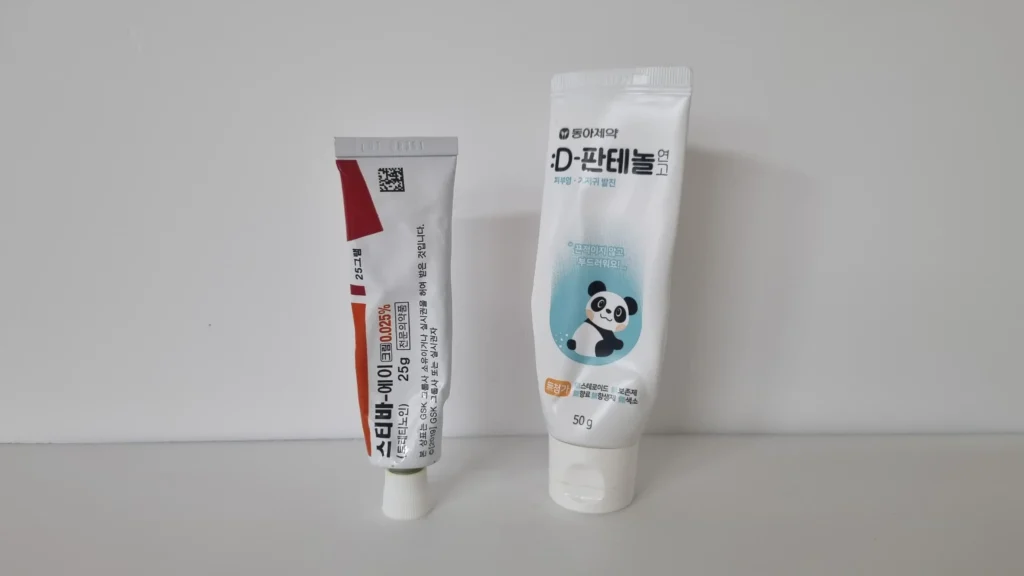
My skin recovery duo: Stieva-A Cream 0.025% (Tretinoin Cream), D-Panthenol Ointment (Panthenol 5%, A Korean Pharmacy Product I Always Keep at Home)
The two products that taught me an important skincare lesson: a prescription retinoid cream and a simple panthenol cream. One helped improve skin texture, while the other helped my skin recover when irritation appeared.
The Side Effects I Experienced
At first, everything seemed fine.
But after a few applications, my skin became:
- Red
- Tight
- Dry
- Sensitive
Even products that normally felt comfortable started to sting.
Looking back, I believe my skin barrier became irritated.
These reactions are actually common with retinoids and retinol products, especially during the first weeks of use. Redness, dryness, peeling, and irritation are well-known side effects.
As someone in her 50s, I found that my skin recovered more slowly than it did when I was younger.
What Helped My Skin Recover
When my skin became irritated, I stopped using the retinoid cream temporarily.
Instead, I focused on barrier repair.
One product that helped me personally was a simple panthenol cream from a local Korean pharmacy.
Whenever my skin became red and uncomfortable, I applied the cream for a few days.
The redness gradually improved, and my skin felt calmer.
Panthenol (Provitamin B5) is widely used in skincare because it helps support hydration and skin barrier recovery. Research has also identified panthenol as a useful ingredient for reducing irritation associated with retinol use.
For me, it became a useful “emergency product” whenever my skin felt overwhelmed.
Korean Pharmacy Tip: Panthenol Ointments You Can Buy Without a Prescription
When my skin becomes irritated from active ingredients like retinoids, I usually simplify my routine and focus on skin barrier repair.
One ingredient that has helped me personally is Panthenol (Provitamin B5), which is widely used in Korea for soothing irritated and damaged skin. Panthenol is known for supporting hydration and helping the skin barrier recover.
Here are some common panthenol-based products you can find in Korean pharmacies:
| Product | Main Ingredient | Approximate Price |
|---|---|---|
| D-Panthenol Ointment (Dong-A Pharmaceutical) | Dexpanthenol 5% | ₩8,000–12,000 |
| Dipan Cure Cream | Dexpanthenol + moisturizing ingredients | ₩8,000–15,000 |
| Various Generic Dexpanthenol Creams | Dexpanthenol 5% | ₩5,000–10,000 |
Prices can vary depending on the pharmacy and location. Tourist areas sometimes charge slightly more than neighborhood pharmacies.
My Personal Experience
Whenever my skin became red and irritated after using a prescription retinoid cream, I would stop all active ingredients and apply D-Panthenol Ointment for a few days.
I can’t say it will work the same way for everyone, but in my case, it helped calm the redness and made my skin feel much more comfortable.
That experience taught me an important lesson:
A healthy skin barrier is often more important than using stronger skincare products.
The Lesson I Learned
This experience changed the way I think about anti-aging skincare.
For years, I assumed stronger products would automatically give better results.
Now I believe something different.
A strong skin barrier is more important than using the strongest active ingredient possible.
Even highly effective ingredients can become problematic when your skin is irritated or dehydrated.
What I Do Today
Today, I still respect the benefits of retinoids.
But I am much more cautious.
I focus on:
- Hydration
- Skin barrier support
- Sunscreen
- Consistency
If my skin feels irritated, I simplify my routine immediately.
In my experience, healthy skin responds better to treatment than stressed skin.
Final Thoughts
Retinoids remain one of the most effective anti-aging ingredients available.
However, they are not magic.
For me, the biggest lesson was learning that skin barrier health comes first.
A powerful ingredient can help your skin, but only if your skin is healthy enough to tolerate it.
Sometimes the most valuable product in your routine isn’t the strongest one.
It’s the simple product that helps your skin recover.
FAQ
Retinoids are stronger vitamin A derivatives, often available by prescription. Retinol is a gentler over-the-counter version commonly found in skincare products.
Retinoids increase skin cell turnover, which can temporarily cause dryness, redness, irritation, and peeling.
Yes. Irritated or compromised skin is often more sensitive to active ingredients, including retinoids.
Panthenol (Provitamin B5) is a moisturizing and barrier-supporting ingredient commonly used in skincare products.
Many dermatologists recommend starting slowly and gradually increasing use to help minimize irritation.
Links
Why Korean Women Over 50 Care More About Skin Barrier Than Anti-Aging
The 3 Brightening Ingredients That Actually Worked for Me at 50
The 5 Biggest Skincare Mistakes I Made Before Turning 50
Do Korean Women Still Follow the 10-Step Korean Skincare Routine?
What Is Skin Longevity? The Korean Slow-Aging Trend Replacing Anti-Aging