
How My Skincare Routine Changed After Menopause
The Effects of Retinol on Enlarged Pores
Introduction
When I was younger, my skincare concerns were mostly about brightening and preventing wrinkles.
After menopause, however, my skin changed in ways I didn’t expect.
My skin became drier.
Redness appeared more often.
And the most frustrating change was my pores.
The pores around my nose and cheeks became much more noticeable, almost like orange peel texture.
Like many women, I started searching for solutions.
Again and again, I came across one recommendation: retinoids.
The Biggest Skin Change I Noticed After Menopause
For me, the most visible change wasn’t wrinkles.
It was enlarged pores and rougher skin texture.
The area around my nose and inner cheeks became much more noticeable than before.
At first, I assumed I simply needed stronger anti-aging products.
But over time, I realized that menopause affects the skin in several ways:
- Reduced collagen production
- Increased dryness
- Slower skin renewal
- Loss of elasticity
All of these changes can make pores appear larger.
Why I Started Using a Prescription Retinoid
After reading recommendations and speaking with my doctor, I started using a prescription retinoid cream.
Retinoids are widely considered one of the most effective ingredients for improving skin texture, fine lines, and enlarged pores.
Retinoids work by speeding up skin cell turnover and supporting collagen production, which can improve skin texture, fine lines, and the appearance of enlarged pores over time.
At first, I was excited.
But I quickly learned that stronger doesn’t always mean easier.
My skin became:
- Red
- Dry
- Sensitive
- Flaky
I realized I needed a way to use the treatment without damaging my skin barrier.
The Simple Change That Helped Me Continue
Instead of applying the retinoid alone, I started mixing a small amount with moisturizer.
This made a noticeable difference.
The moisturizer helped reduce irritation while allowing me to continue using the retinoid more comfortably.
I also became much more careful about cleansing and sun protection.
My routine became surprisingly simple.
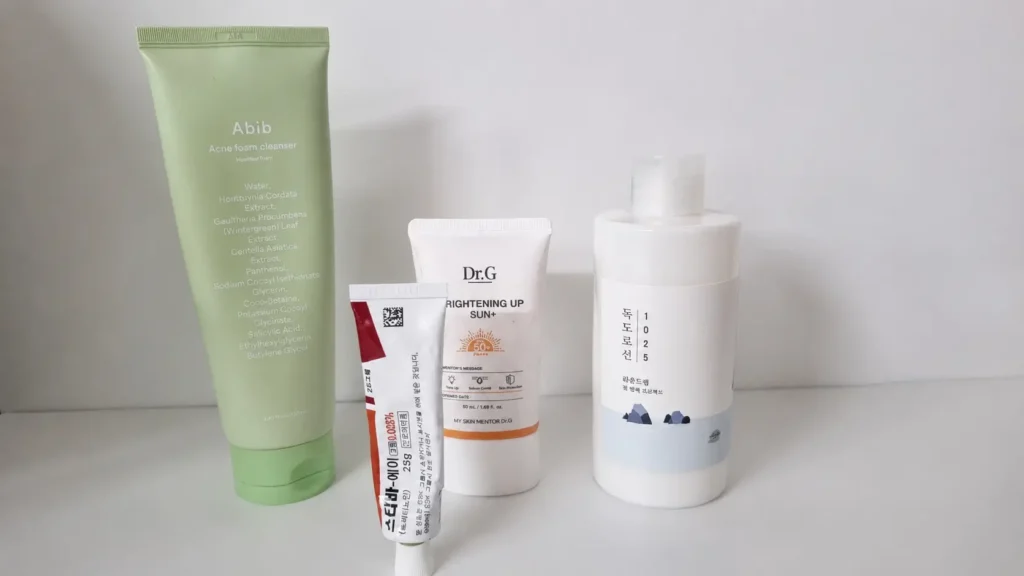
My Minimal Tretinoin Routine: Cleanser, Tretinoin, Dokdo Lotion, and SPF. Sometimes, less really is more.
My Current Routine
Evening
- Gentle cleansing
- Moisturizer mixed with a small amount of prescription retinoid
- Additional moisturizer if needed
Morning
- Thorough cleansing
- Hydrating skincare
- Sunscreen every single day
Even on days when I stay home, I never skip sunscreen.
The Two Products That Matter More Than People Think
When people talk about retinoids, they often focus only on the treatment itself.
But in my experience, two other products are just as important.
A Good Moisturizer
A moisturizer helps support the skin barrier and reduce irritation.
Without enough hydration, retinoids can become difficult to tolerate.
Sunscreen
This may be the most important step of all.
Retinoids can make the skin more sensitive to sunlight.
Without sunscreen, you may undo many of the benefits you’re trying to achieve.
If I had to choose only one anti-aging product, sunscreen would still win.
What Actually Improved My Skin
Interestingly, the biggest improvement didn’t come from using stronger products.
It came from using the right products consistently.
The combination of:
- Prescription retinoid
- Moisturizer
- Daily sunscreen
worked better than many complicated routines I tried in the past.
Over time, my skin texture looked smoother and my pores became less noticeable.
The improvement wasn’t overnight.
But it was real.
What Menopause Taught Me About Skincare
Menopause completely changed how I think about skincare.
In my 40s, I was always looking for the next miracle product.
Today, I focus on:
- Consistency
- Hydration
- Skin barrier health
- Daily sun protection
I still use active ingredients, but I respect them more.
I’ve learned that healthy skin isn’t about using the strongest treatment.
It’s about creating a routine your skin can tolerate for years.
Final Thoughts
Menopause brought challenges I wasn’t expecting, especially enlarged pores, dryness, and increased sensitivity.
For me, a prescription retinoid has been helpful.
But the real lesson was that retinoids don’t work alone.
Moisturizer and sunscreen became just as important as the treatment itself.
Today, my skincare routine is much simpler than it was ten years ago.
And honestly, my skin is happier because of it.
For Readers Looking for a Gentler K-Beauty Alternative
Primera VitaTinol Bouncy Lift Serum
If prescription retinoids feel too strong, a gentler option is the Primera VitaTinol Bouncy Lift Serum. It combines retinol and vitamin-based ingredients in a formula that is easier for sensitive or mature skin to tolerate.
FAQ
Yes. Reduced collagen and elasticity can make pores appear more noticeable after menopause.
Retinol is a cosmetic skincare ingredient, while tretinoin is a prescription-strength retinoid that is much stronger.
Yes. Redness, dryness, and peeling are common side effects, especially when starting treatment.
Retinoids can increase sensitivity to sunlight, making daily sunscreen especially important.
Many dermatologists consider daily sunscreen, hydration, and skin barrier support to be the foundation of healthy aging skin.
Recommended Internal Links
The Korean Skincare Ingredients That Helped My Redness More Than Retinol
My Favorite Brightening Ingredients After 50: Vitamin C, Niacinamide, and Retinol
Top 10 Olive Young Best Sellers: The Exact Skincare Products Locals Actually Buy in Korea
Why Korean Women Over 50 Care More About Skin Barrier Than Wrinkles